
New results show 13% faster startup, memory near parity, 5.6% lower H.264 CPU, 25.8 ms AI panel readiness and zero retained processes in sustained testing.
San Francisco, CA (PRUnderground) October 15th, 2026
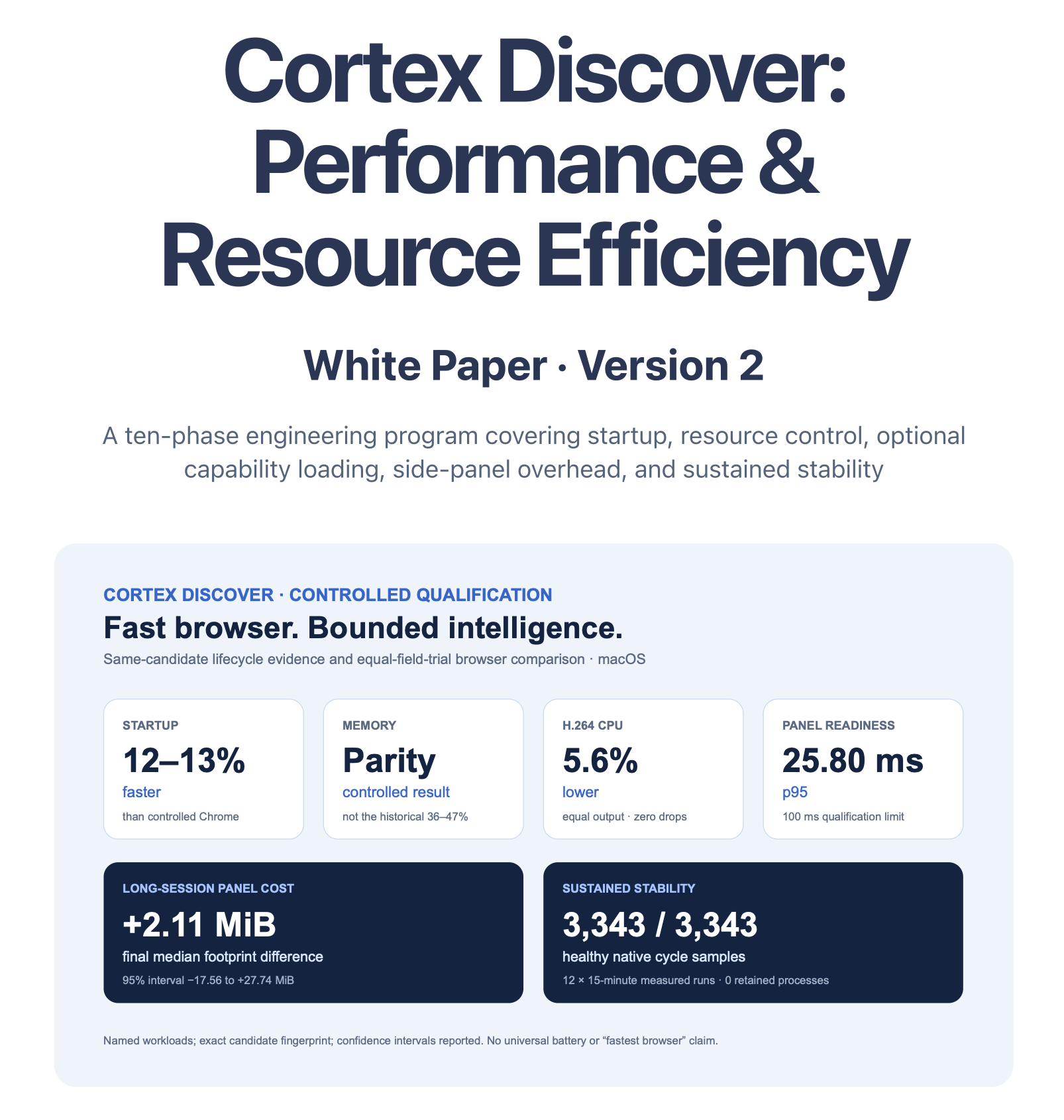
Pervaziv AI today released a significant update to its Cortex Discover performance program, extending the company’s earlier six browser study into a ten phase engineering and qualification effort focused on the long term cost of putting artificial intelligence directly inside the browser.
The new work asks a more demanding question than the original benchmark:
Can an agentic browser stay fast once the AI becomes a persistent part of everyday work?
For the tested Cortex Discover candidate, the answer was yes.
Updated controlled testing on macOS measured Cortex Discover startup approximately 12 to 13% faster than Chrome for Testing while memory usage remained near parity. Rendering and workload throughput were effectively equivalent, while background readiness and interaction responsiveness were also close to parity.
A separate deterministic H.264 workload measured Cortex Discover CPU and CPU time 5.6% lower than Chrome, with equivalent decoded output and zero dropped frames for both browsers.
More importantly, Pervaziv AI moved beyond short browser measurements and subjected the integrated Cortex experience to sustained qualification.
Twelve measured 15 minute sessions tested Cortex Discover with the AI panel closed, open under demanding workloads and repeatedly opened and closed. All twelve runs completed successfully. The final campaign recorded 25.80 millisecond panel readiness at the 95th percentile, 3,343 healthy native cycling samples out of 3,343 observations and zero retained processes during measured cycle runs.
The result gives Pervaziv AI a new performance foundation for Cortex Discover: not a claim that artificial intelligence is free, but evidence that it can remain integrated into the browser without allowing the always available experience to become progressively heavier.
We Began by Challenging Our Own Strongest Result
The performance update started by going back to the most favorable result from the original Cortex Discover browser study and testing it again under tighter conditions.
The earlier campaign had reported substantially lower memory consumption than Chrome in several scenarios. Further qualification showed that differences in browser process conditions had materially influenced those comparisons.
The new program applied equivalent controls and reached a different conclusion: Cortex Discover and Chrome were near memory parity under the updated controlled workload.
Pervaziv AI retired the earlier memory headline rather than continue using a result that the stronger methodology no longer supported.
That decision ultimately produced a more important story.
The question was no longer whether Cortex Discover could win an isolated browser ranking. The question became whether Pervaziv AI could add page aware AI, reasoning, persistent conversations and agentic capabilities while preserving the performance expected from a modern browser.
The ten phase program was built around proving that.
Better measurement changed the headline. It also raised the standard.
From Browser Speed to AI Efficiency
Cortex Discover is designed as an agentic AI browser rather than a conventional browser with an assistant attached to the side.
The browser can combine the page a user is viewing with selected tab context, visual information, files, conversations and supported actions.
That creates a different performance problem from a traditional browser.
An AI experience can feel fast when it first opens while still accumulating work over time. Interfaces can become heavier as conversations grow. Background activity can continue when capabilities are not actively being used. Repeated sessions can create overhead that short benchmarks never reveal.
For an agentic browser designed to stay open throughout the workday, those costs matter.
The Cortex Discover update therefore focused on the complete operating experience rather than optimizing one benchmark in isolation.
The program progressed from repeatable measurement into resource controls and then into sustained qualification. Its central principle was simple: everyday browsing should carry only the cost required for everyday browsing, while more intensive intelligence should consume additional resources when that intelligence is actually being used.
That principle allowed Pervaziv AI to evaluate Cortex Discover as both a browser and an AI environment.
13% Faster Startup
Startup remains one of the clearest advantages measured in the updated browser comparison.
Under the controlled macOS workload, Cortex Discover launched approximately 12 to 13% faster than Chrome for Testing.
For a product intended to become part of daily enterprise workflows, startup speed matters because the AI experience should not come at the expense of the fundamental browser experience.
The updated results also intentionally avoid turning that metric into a universal fastest browser claim.
The qualification applies to specific candidates, workloads and test conditions. Different hardware, operating environments and browsing behavior can produce different results.
That narrower framing makes the result more credible.
Cortex Discover did not achieve its startup advantage by sacrificing workload completion elsewhere. Rendering and fixture throughput remained effectively equal to the controlled Chrome baseline, while background readiness and interaction responsiveness were also close to parity.
The result is a browser that preserves competitive core performance while carrying an integrated AI experience alongside it.
Fast When AI Is Open. Quiet When It Is Not.
One of the most important goals of the program was controlling what happens when Cortex is available but not actively performing intensive work.
That distinction matters because an AI browser should not force users to choose between constant intelligence and reasonable system resources.
The qualification evaluated Cortex Discover with the AI surface closed, open and repeatedly cycled during the same browsing lifecycle.
At the end of the sustained campaign, the final median physical footprint difference relative to the panel closed condition was just +2.11 MiB.
The measured interval remained within the program’s declared qualification boundary.
That does not mean every AI operation consumes only a few megabytes. Running models, analyzing documents, executing security workflows or performing other AI tasks naturally requires additional computing resources.
The result instead addresses the persistent integrated surface itself.
Cortex Discover can keep AI available without automatically multiplying its browser footprint simply because users move repeatedly between the panel and the web.
For Pervaziv AI, that is a more meaningful measure of AI browser efficiency than a single short duration memory chart.
3,343 Cycles. 3,343 Healthy Samples.
Long duration behavior became the final test.
The qualification campaign completed twelve measured 15 minute runs across three conditions: panel closed, panel open with demanding content and repeated native panel cycling.
Across the repeated cycling workload, all 3,343 samples found the expected healthy browser state.
No measured cycling run finished with an additional retained browser process.
The workload also exercised demanding interface states including larger history views, security review information and streamed AI responses.
Panel readiness reached 25.80 milliseconds at the 95th percentile, comfortably below the program’s 100 millisecond qualification threshold.
Those numbers address a performance characteristic users experience directly.
Opening an AI surface once is easy.
Keeping it responsive after continued browsing, repeated switching and longer conversations is harder.
The Cortex Discover program was designed to test that difference.
The goal is not merely fast AI. It is AI that stays fast.
Media Performance Without the Penalty
Pervaziv AI also revisited media performance during the updated qualification.
An earlier short diagnostic had suggested an approximately 11% CPU disadvantage during synthetic video playback.
Longer testing showed that signal was not stable.
Pervaziv AI then ran a deterministic H.264 workload. In that qualification, Cortex Discover recorded 5.6% lower CPU consumption and CPU time than Chrome, while memory and decoded frame output remained at parity and both browsers completed the workload without dropped frames.
The result is deliberately scoped to the tested workload. It is not presented as a universal claim across every codec, video conferencing platform or streaming service.
But it matters for the broader performance story.
Agentic browsing does not happen in isolation. Users still watch video, interact with complex web applications, research information and move through conventional browsing workloads while AI remains available.
An intelligent browser must perform well at being a browser first.
Performance as an Architectural Contract
The biggest shift behind this update may be how Pervaziv AI now treats performance itself.
The first Cortex Discover study was primarily comparative.
The new ten phase program turns performance into an ongoing qualification requirement.
The work progressed from establishing reliable baselines into controlling unnecessary overhead and finally proving that the results continued to hold through sustained operation.
That distinction matters as Cortex Discover becomes more capable.
AI products naturally gain new models, tools, workflows and user experiences over time. Without resource discipline, every additional capability can increase startup work, memory consumption or background activity.
Cortex Discover follows a different principle: more intelligence should not automatically mean a heavier everyday experience.
Performance therefore becomes something that new capabilities must preserve, not something evaluated only after features have been added.
Performance is no longer a one time benchmark. It is part of the product contract.
That principle extends beyond browser speed.
It reflects how Pervaziv AI believes artificial intelligence should operate when it becomes a persistent part of professional computing.
Built for Everyday Agentic Work
Cortex Discover was introduced to move AI in the browser beyond answering questions about a webpage.
It brings the broader Cortex experience directly into browsing, enabling intelligence to work with live page context, selected tabs, visual information, files and supported browser actions while maintaining continuity with other Cortex experiences.
The latest performance update strengthens that vision by addressing the cost of making AI persistent.
A browser may stay open for hours.
Conversations grow.
Tabs accumulate.
Users move repeatedly between websites and AI.
Development, research and security workflows cross multiple sources and contexts.
Those are not edge cases for an agentic browser. They are the operating environment.
The new qualification demonstrates that the tested Cortex Discover candidate can remain responsive through those patterns while keeping its integrated AI surface bounded and measurable.
“AI performance should not be measured only by how quickly intelligence appears,” said Anoop Jaishankar, Founder and CEO of Pervaziv AI. “It should stay responsive and resource conscious as people keep working. That is the standard we are building Cortex Discover around.”
The statement captures the larger direction behind the update.
AI is moving closer to where work happens.
For developers, that may mean moving between technical documentation, repositories, development environments and browser based systems.
For security teams, it can mean moving from investigation to evidence, analysis and remediation.
For enterprise users more broadly, it can mean combining web applications, files, research and connected workflows without continually rebuilding context.
As intelligence moves into those environments, it cannot simply be added on top of the computing stack without regard for operational cost.
It has to remain practical enough to stay there.
Fast Browser. Bounded Intelligence.
The latest Cortex Discover update does not depend on claiming that AI has no cost or that one browser wins every possible benchmark.
It establishes something more useful.
Under the tested conditions, Cortex Discover remained faster at startup than the controlled Chrome baseline, reached memory near parity, maintained competitive browser responsiveness, used 5.6% less CPU in the qualified H.264 workload and sustained its integrated AI surface through extended operation without retained process accumulation.
That is the new performance story.
Not AI bolted onto a browser.
Not a benchmark optimized around one favorable chart.
A fast browser with intelligence engineered to stay within bounds.
Cortex Discover is available for Windows and macOS as part of the broader Cortex Enterprise AI platform.
Explore the Whitepapers
The original Cortex Discover performance whitepaper is available at pervaziv.com/white-papers/, with the updated report to be published there as well. Readers may also contact Pervaziv AI to request the complete versions of both whitepapers.


