BAODING, HEBEI, CHINA, October 8, 2026 /EINPresswire.com/ — Factories are becoming more automated, but many lifting tasks still take place far from permanent power, outside fixed crane coverage, or inside spaces where large equipment cannot enter. Construction projects, repair teams, warehouses, shipyards, mines, farms, and utility contractors all need a dependable way to raise and position loads at temporary work points. This is why the manual chain block remains relevant even as electric lifting technology advances.
A chain block requires no external electrical supply or fuel. The operator pulls the hand chain, the internal gearing multiplies the effort, and the load chain raises or lowers the hook. The principle is simple, but the value is significant: the tool is portable, easy to deploy, and capable of controlled lifting in locations where an electric hoist would require cables, power distribution, or additional installation.
Global buyers also appreciate the wide capacity range available in manual hoists. A compact unit can support maintenance in a workshop, while higher-capacity models can assist with construction, machinery installation, or heavy repair. Because the tool is frequently used in temporary rigging, selection and inspection must be especially disciplined. Portability does not reduce the need for a certified support point, correct rigging, and trained operation.
Factories are becoming more automated, but many lifting tasks still take place far from permanent power, outside fixed crane coverage, or inside spaces where large equipment cannot enter. Construction projects, repair teams, warehouses, shipyards, mines, farms, and utility contractors all need a dependable way to raise and position loads at temporary work points. This is why the manual chain block remains relevant even as electric lifting technology advances.
A chain block requires no external electrical supply or fuel. The operator pulls the hand chain, the internal gearing multiplies the effort, and the load chain raises or lowers the hook. The principle is simple, but the value is significant: the tool is portable, easy to deploy, and capable of controlled lifting in locations where an electric hoist would require cables, power distribution, or additional installation.
As a global leading chain blocks supplier, we see why global buyers appreciate the wide capacity range available in manual hoists. A compact unit can support maintenance in a workshop, while higher-capacity models can assist with construction, machinery installation, or heavy repair. Because the tool is frequently used in temporary rigging, selection and inspection must be especially disciplined. Portability does not reduce the need for a certified support point, correct rigging, and trained operation.
Why a Manual Chain Block Still Matters for Power-Free Lifting
Remote and developing project sites may have limited electrical infrastructure. Even in advanced factories, maintenance teams often need to work during shutdowns when power is isolated for safety. A manual hoist can continue to function in these conditions and can be positioned wherever a suitable beam, trolley, tripod, gantry, or engineered anchor is available.
Manual operation also provides direct control at low speed. This is useful when aligning machinery, tensioning an assembly, removing a motor, or lowering a component into a narrow space. The operator can make small adjustments without configuring a motor or control system. For occasional lifts, the simplicity of the device may also reduce installation cost and storage requirements.
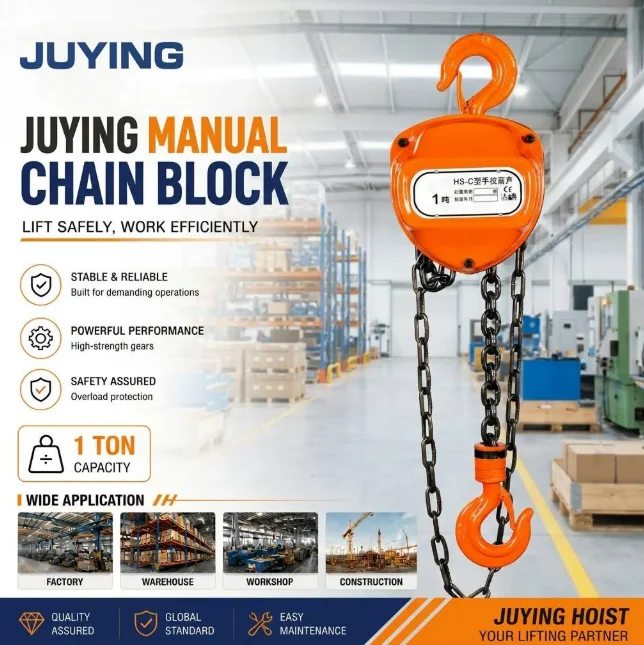
Juying’s Manual Chain Block range includes HSZ, HSZ-T, VD, VC, VT, and other series for different capacities and application preferences. The products are presented for factories, warehouses, construction sites, maintenance work, and general industrial lifting. Buyers should compare housing design, load chain specification, brake mechanism, hook construction, hand effort, lifting height, and certification.
Chain Block and Lever Block Configurations for Different Tasks
The 2 Ton Chain Pulley Block Manual Chain Hoist is described as a compact round manual hoist for light- to medium-duty industrial and commercial work. The product information highlights a high-strength alloy steel chain, robust gear system, corrosion-resistant housing, reliable braking, and easy transport. A 2-ton rating can cover many common workshop and construction tasks, but the actual lift must remain within the rated capacity.
The HSZ-T design is positioned as a portable, labor-saving hand chain hoist for factories, warehouses, construction sites, and workshops. The VC and VD series provide additional choices in body design and capacity. Juying also lists manual chain hoists across broad capacity ranges, giving distributors the ability to serve maintenance users, contractors, and industrial plants with different load requirements.
Lifting height is another major variable. Standard products may be supplied with common chain lengths, while a project can require a longer lift. Increasing the chain length affects weight, handling, storage, and sometimes the suitability of the supporting structure. Buyers should confirm both lift height and hand-chain operating height, especially for elevated installations.
Manual Hoist Applications from Construction to Maintenance
Construction teams use chain blocks to lift steel members, tools, pipes, formwork components, and mechanical equipment. The hoist can be moved between work areas and used with temporary gantries or engineered lifting points. Its power-free operation is especially useful before permanent electricity is available or during controlled shutdowns.
In factories, maintenance departments rely on manual hoists for removing motors, pumps, gearboxes, machine covers, and rollers. A chain block can be stored near a production line and installed when needed. Because maintenance lifts are often infrequent but critical, equipment condition should be checked before every use rather than assumed from low usage.
Warehouses and logistics facilities use manual chain hoists for handling irregular goods, service work, and equipment installation. Shipyards and marine repair teams value portability, although corrosion exposure requires careful inspection and maintenance. Mining and energy operations may use manual hoists in remote areas, but they must consider dust, moisture, hazardous environments, and any special certification requirements.
Agricultural operations can use chain blocks in barns, equipment sheds, and repair areas for lifting engines, implements, gates, or machinery components. Utility and field-service teams may carry compact hoists for emergency repairs. Across these applications, the common value is controlled lifting without dependence on a fixed power source.
How Load Chain and Brake Quality Define Long-Term Reliability
The load chain carries the working load and must be treated as a precision component. Wear, stretching, corrosion, bending, gouging, and poor lubrication can reduce safety. A chain should run smoothly through the hoist without twisting or jumping. It should never be used as a sling around the load, and it should not be repaired by welding or unauthorized modification.
The braking system holds the load when the operator stops pulling. Double-pawl or related mechanical brake designs are widely used in quality manual chain hoists. Buyers should ask how the brake is tested, what friction components are used, and which maintenance procedures are recommended. A load should be raised slightly before the main lift to confirm that the brake and rigging are functioning correctly.
Hooks and hook latches also require inspection. The hook should rotate freely where designed, show no cracks or excessive opening, and engage the load at the bowl rather than the tip. The top hook or suspension point must be securely attached to a structure rated for the load. Side loading and twisting can create forces the hoist was not designed to carry.
What Global Buyers Should Expect from a Chain Block Manufacturer
Hebei Juying Hoisting Machinery Co., Ltd. states that it was established in 2005 and owns the GSTOYO brand. The company reports more than 20 years of experience, over 150 staff members, around 40,000 square meters of land area, and more than 100 production lines. Its product scope includes manual and electric hoists, lifting chains, slings, winches, magnetic lifters, and material-handling equipment.
The company lists ISO9001, CE, GS, and TUV certifications. Manual hoist buyers should request the documents applicable to the model they are purchasing and check labeling, rated capacity markings, manuals, and test information. For distributors, consistent model identification and spare-parts support are important because users may keep manual chain blocks in service for many years.
A manufacturer with several chain block series can help match different regional preferences. Some markets favor a round housing, while others focus on low hand effort, compact dimensions, or familiar series names. Custom chain length, hooks, packaging, labels, and documentation may also be relevant for wholesale and private-label orders.
Manual Chain Block Inspection, Training, and Responsible Use
Before each lift, the operator should inspect the housing, chain, hooks, latches, hand chain, brake response, and suspension. The chain should not be knotted or twisted. The load must be balanced and attached with suitable slings or accessories. The working area should be clear, and no one should pass under a suspended load.
Operators should avoid shock loading, rapid pulling, side pulling, and using excessive force when the hoist stops. A sudden increase in hand effort can indicate overload, misalignment, or an internal problem. The correct response is to stop, lower the load safely, and investigate rather than forcing the mechanism.
Periodic inspections should be documented according to use frequency and local regulations. Units exposed to outdoor conditions, corrosive environments, or heavy service may need more frequent examination. Damaged equipment should be removed from service and repaired only by qualified personnel using appropriate parts.
For global buyers, manual chain blocks remain a practical investment because they are versatile, portable, and independent of power. The best results come from matching capacity and lift height to the task, choosing a reliable supplier, and building inspection into everyday work. Buyers can explore Juying’s manual hoist series and request technical guidance for construction, maintenance, warehousing, and industrial applications.
Hebei Juying Hoisting Machinery Co., Ltd.
Hebei Juying Hoisting Machinery Co., Ltd.
+86 177 1329 2520
Legal Disclaimer:
EIN Presswire provides this news content “as is” without warranty of any kind. We do not accept any responsibility or liability
for the accuracy, content, images, videos, licenses, completeness, legality, or reliability of the information contained in this
article. If you have any complaints or copyright issues related to this article, kindly contact the author above.

Media gallery