
Key Takeaways
- Organic reach on most major platforms has dropped to single digits – Facebook’s organic reach ranges from approximately 0.42% to 2.58%, and Instagram sits closer to 3.5% to 4% – meaning most posts are invisible to the majority of an audience.
- Organic social still earns its place in a strategy: it builds trust, tests messaging, and warms audiences before any money is spent on ads.
- Paid social accelerates results with precision targeting, but content tested organically first consistently outperforms cold ad launches.
- A hybrid approach – organic for credibility, paid for scale, and multi-channel distribution for long-term reach – is what separates brands that grow from those that plateau.
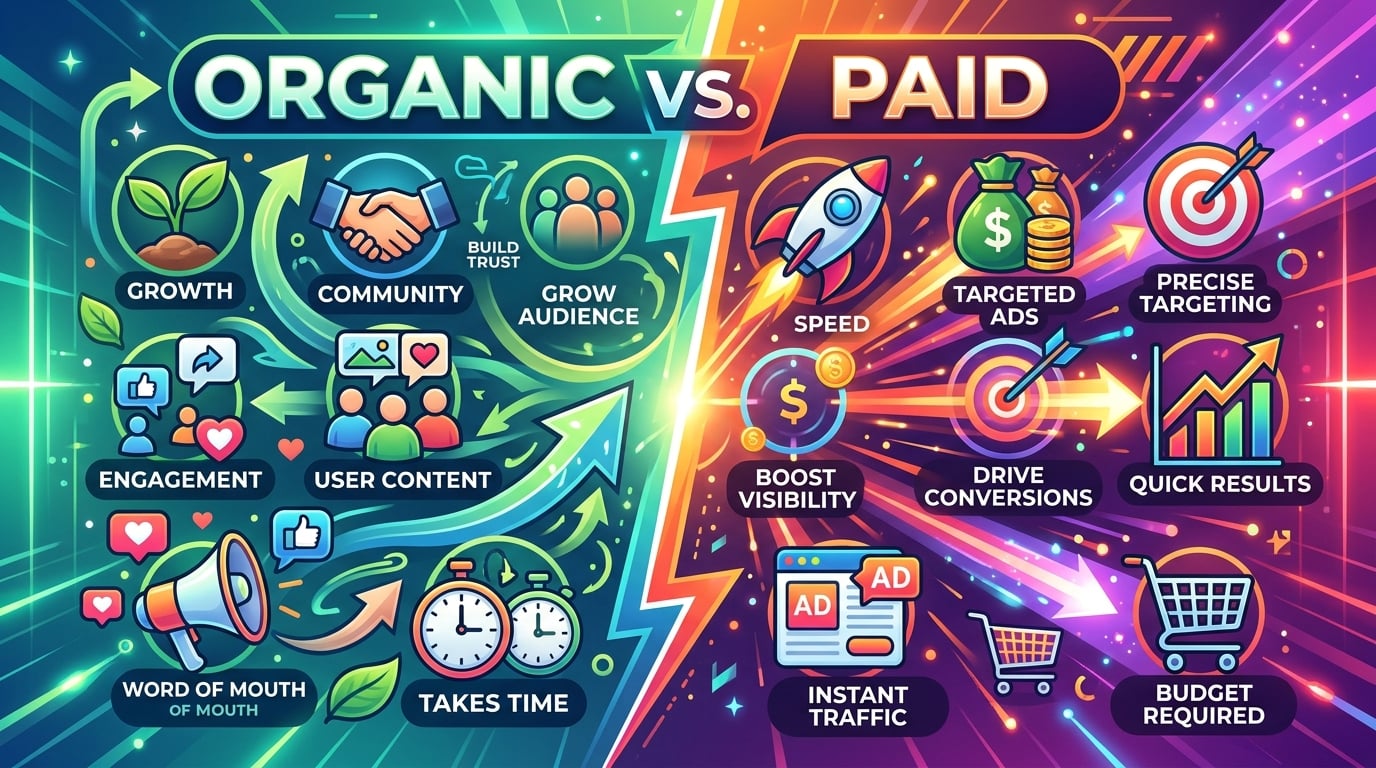
- Understanding the key differences between organic and paid social (cost, speed, control, and measurement) helps businesses decide where to focus time and budget at each growth stage.
Social media reach was once practically free. Post something valuable, and the platform would deliver it to thousands of followers. That era is over. Today, reach has to be earned, paid for, or engineered – and for most small and mid-sized businesses, figuring out the right mix is where strategy either clicks or breaks down.
Organic Reach Has Collapsed on Most Platforms – But Not All
The numbers are hard to ignore. Facebook’s organic reach dropped from 16% in 2012 to a range of roughly 0.42% to 2.58% by 2023-2024, according to industry tracking data. Instagram fares somewhat better, with average organic reach sitting between 3.5% and 4% of followers – still meaning the vast majority of an audience never sees a given post.
Not every platform has hit the same wall. LinkedIn leads with an organic reach rate of around 1.68% – modest in absolute terms, but consistently outperforming Facebook and TikTok (0.44%) when measured against follower base. TikTok’s discovery reach operates differently: the For You Page surfaces content to non-followers, which is why it still rewards organic creators disproportionately compared to its raw follower-reach figure.
As AmpiFire outlined, the takeaway is not that organic is dead. Organic alone, on most platforms, can no longer carry a brand’s reach strategy by itself.
What Is Organic Social Media Marketing?
Organic social media is any content published without paid promotion – posts, reels, stories, threads, replies, and comments that reach people through algorithms, hashtags, shares, or an existing follower base. There is no ad spend involved, but that does not mean it is free: it costs time, strategy, and creative consistency.
Examples of Organic Content
Behind-the-scenes videos, customer testimonials, product tips, industry commentary, and Q&A replies in comments are all organic. Their reach depends entirely on how the platform’s algorithm judges the content and how the audience responds to it. Strong engagement earns distribution; weak engagement disappears quietly.
Platforms That Still Reward Organic
Short-form video platforms – especially TikTok and YouTube Shorts – still surface content to non-followers at scale. Pinterest functions more like a search engine, giving posts long shelf lives. LinkedIn continues to amplify thoughtful professional content beyond an existing network. Facebook and Instagram, by contrast, have largely shifted toward rewarding paid promotion for consistent reach.
What Is Paid Social Media Marketing?
Paid social is content promoted by paying the platform directly to reach a defined audience. Unlike organic posts, paid campaigns bypass algorithms entirely – guaranteed placement is the point. This control makes paid social the fastest path to visibility, especially for time-sensitive goals like product launches, promotions, or lead generation.
How Targeting Works
Paid social allows targeting by demographics, interests, online behaviors, job titles, and even life events. Platforms also support custom audiences built from an existing contact list, and lookalike audiences that mirror high-value customers. This precision means the right message reaches the right person at the right moment, rather than being left to algorithmic chance.
Choosing the Right Platform
Meta (Facebook and Instagram) reaches broad B2C audiences across age groups. LinkedIn is the go-to for B2B targeting by role, industry, or company size. TikTok skews toward under-35 demographics and thrives on video-native content. Pinterest attracts high-intent lifestyle and product shoppers. Matching platform to audience behavior is what makes a paid budget work – or waste.
Organic vs. Paid: Key Differences at a Glance
Cost, Speed, and Control
Organic social carries hidden costs – primarily time and creative labor – but no direct ad spend. Paid social requires budget, but delivers speed and control that organic cannot match. A paid campaign can drive traffic, leads, and conversions within hours of going live. Organic strategies build steadily over months.
The control gap is equally significant. With organic, the algorithm decides who sees the content and when. With paid, every variable – audience, timing, placement, frequency – is set by the advertiser.
Reach and Measurement
Organic reach is capped by follower count and algorithmic favor. Paid reach scales to any audience size, with no ceiling. Measurement also differs: organic metrics center on engagement, shares, and reach signals; paid metrics drill into conversions, cost-per-click, return on ad spend, and direct revenue attribution. Both forms of data are useful, but they answer different questions.
When to Use Each – or Both
When Organic Works Best
Organic social is the right tool for community building, brand storytelling, customer education, and relationship maintenance. It is also the smartest way to test content before spending money on it. Nearly 75% of consumers research brands on social media before buying, and consistent, authentic content over time is what builds the kind of trust that ad impressions alone cannot replicate.
When Paid Delivers Better ROI
When the goal is measurable, time-bound, and tied to a specific audience action – a purchase, a form fill, a demo booking – paid social is the better tool. AI-optimized paid social campaigns are reportedly delivering strong ROI in 2026, driven by real-time creative personalization and predictive audience segmentation. Product launches, seasonal promotions, and retargeting warm audiences all benefit from the speed and precision that paid ads provide.
How to Build a Hybrid Strategy That Actually Works
The brands consistently winning on social are not choosing between organic and paid – they run both as a coordinated system. Gymshark is a well-documented example: rather than producing separate ad-like creative, the brand identifies its best-performing organic content and amplifies it through paid campaigns. The result is paid spend that backs already-validated messaging, not a gamble on untested creative.
Test Organic First, Then Boost What Wins
Publish content organically and monitor engagement signals – saves, shares, comments, click-throughs. Posts that earn strong organic traction have already been validated by a real audience. Boosting those posts with paid spend extends proven messaging to new audiences, making every ad dollar work harder. Content pushed out cold, without organic validation, carries far more risk.
Align Goals in One Unified Content Plan
A unified content calendar maps organic and paid efforts to the same business objectives, campaign moments, and audience journey stages. Organic content nurtures and educates; paid content converts and scales. When both share consistent messaging, visuals, and tone, every touchpoint reinforces the last – and that compounding familiarity turns impressions into trust, and trust into revenue.
Extend Reach Beyond Social With Multi-Channel Distribution
Even a well-funded hybrid strategy has a ceiling: social platforms only reach people who are already on social media. Systematic content repurposing and multi-channel distribution can boost content reach by up to 300% and increase overall results by 75% without a proportional increase in investment.
Start Organic, Scale Smart – Your Reach Does Not Have to Be Limited by Algorithms
Organic reach is shrinking, but it has not lost its role. It builds the credibility and audience understanding that makes paid social work better. Paid social scales what is already proven. And multi-channel distribution extends the reach of both into places algorithms and ad budgets alone cannot go.
The most effective path for small and mid-sized businesses is running a coordinated play: test with organic, amplify with paid, and distribute everywhere with tools built for scale.
AmpiFire
support@ampifire.com
London Office 15 Harwood Road, , London, England United Kingdom
London
England
SW6 4QP
United Kingdom


