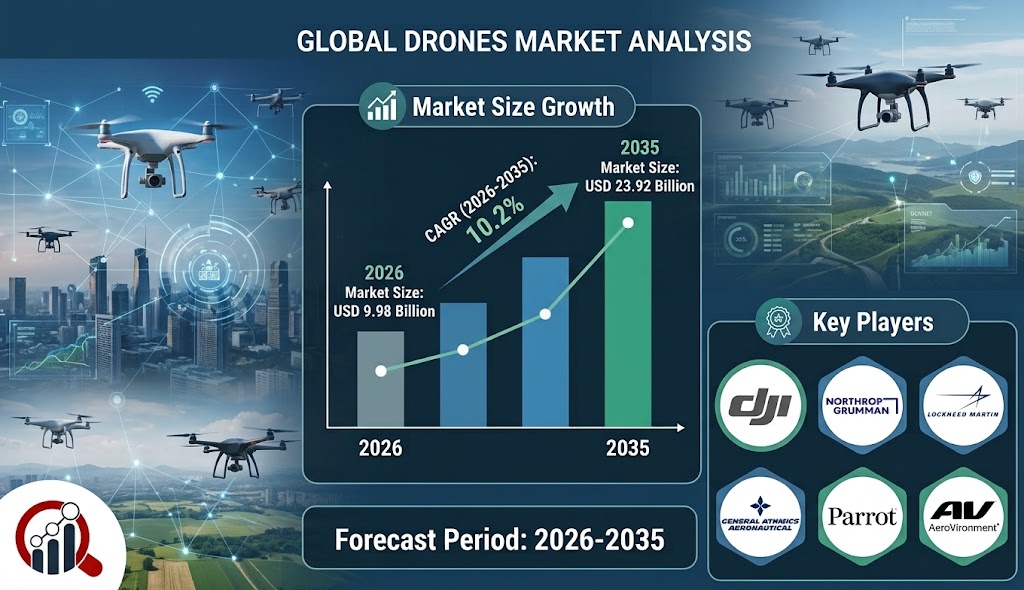
Global drones market was valued at US$ 9.08 billion in 2025 before expanding to US$ 23.92 billion by 2035 with registering of 10.2% CAGR during 2026–2035.
NEW YORK, NY, UNITED STATES, August 24, 2026 /EINPresswire.com/ — The global Drones Market is entering a strong growth phase as businesses, governments, defense organizations, and consumers increasingly adopt unmanned aerial systems for inspection, mapping, agriculture, delivery, surveillance, entertainment, and other applications. The report covers hardware, software, payloads, and services across the global industry.
The expansion reflects a transition from manually controlled aircraft designed for individual missions toward connected, intelligent, and increasingly autonomous platforms. Developments in AI-integrated navigation, BVLOS operations, precision agriculture, drone delivery, and urban air mobility are broadening the addressable market. The report identifies BVLOS regulatory standardization, AI-integrated autonomous navigation, precision agriculture mandates, defense ISR modernization, last-mile delivery, urban air mobility certification, and improvements in battery energy density as important factors influencing growth.
Market Trends:
One of the most important trends shaping the Drones Market is the increasing standardization of beyond visual line of sight operations. Regulatory developments are creating greater certainty for commercial operators and enabling drone missions to move beyond conventional short-distance, manually supervised flights. The report identifies BVLOS regulatory standardization as having an estimated 2.1% impact on CAGR, with particularly strong relevance to North America and Europe. This trend is helping commercial operators consider repeatable inspection, delivery, and monitoring missions at greater scale.
Request Free Sample of Report: https://www.marketresearchfuture.com/sample_request/1124
Another major trend is the integration of artificial intelligence into aerial platforms. AI-enabled systems can support real-time obstacle avoidance, dynamic flight-path changes, and multi-sensor processing. This technological evolution is contributing to the shift from remotely piloted operations toward increasingly autonomous missions. The report identifies AI-integrated autonomous navigation as an important global driver, with an estimated 1.8% impact on CAGR. Such capabilities are particularly relevant to warehouse inventory, infrastructure inspection, delivery, and coordinated multi-drone operations.
Precision agriculture is also becoming an increasingly important area of adoption. Agricultural operators are using aerial systems for crop monitoring, spraying, health mapping, and yield optimization. The agriculture application segment is forecast to grow at an 11.2% CAGR through 2035, making it the fastest-growing application category in the report. This trend demonstrates how precision agriculture technology is transforming drones from general-purpose aerial equipment into specialized productivity tools.
The market is also moving toward service-based business models. Drone-as-a-Service platforms allow enterprises to access inspection, surveying, monitoring, and data-analysis capabilities without purchasing and maintaining complete fleets. According to the report, DaaS providers are growing at roughly twice the overall market rate, creating opportunities for recurring-revenue models and lowering adoption barriers for organizations that do not have internal piloting or maintenance capabilities.
Market Drivers:
Regulatory standardization is a major growth driver for the Drones Market. The report highlights the U.S. FAA’s proposed 14 CFR Part 108 framework and Europe’s U-space deployment as important policy developments. These initiatives are creating more structured environments for low-altitude commercial operations. The report estimates that BVLOS regulatory standardization could contribute approximately 2.1% to CAGR, making regulatory progress one of the strongest near-term influences on market expansion.
Technological innovation represents another fundamental driver. AI processors, improved sensors, edge computing, LiDAR payloads, and autonomous navigation are expanding what drones can accomplish without continuous intervention. These capabilities support the development of advanced unmanned aerial vehicles (UAVs) for inspection, mapping, logistics, and infrastructure monitoring. The report identifies AI-integrated autonomous navigation as having an estimated 1.8% CAGR impact.
Agricultural digitization is further supporting demand. Government incentives and precision-spraying initiatives in countries including India, Brazil, and China are encouraging agricultural operators to adopt aerial systems. The report notes that precision agriculture mandates have an estimated 1.5% CAGR impact and are particularly relevant to Asia-Pacific and South America.
Defense modernization is another sustained source of demand. The report highlights increased procurement of small drone systems, reconnaissance platforms, and autonomous systems for intelligence, surveillance, and reconnaissance missions. Defense ISR modernization is estimated to contribute approximately 1.4% to CAGR and provides a persistent demand base for advanced platforms.
Market Opportunities:
Last-mile delivery represents a significant opportunity within the Drones Market. The report identifies expanding beyond-line-of-sight delivery frameworks and increasing commercial delivery activity as important opportunities. It estimates that last-mile drone delivery could generate an incremental USD 3.5 billion in revenue as delivery density increases. Autonomous delivery platforms could therefore become an increasingly important part of logistics infrastructure, particularly in markets where regulatory conditions and operational economics support scaled deployment.
Drone-as-a-Service is another emerging opportunity. Enterprises can use subscription or managed-service models for inspection, surveying, monitoring, and data collection instead of owning fleets. This approach can reduce upfront investment and provide access to specialized pilots, maintenance, software, and analytics. The model is particularly relevant for mid-sized enterprises that may lack internal technical capabilities.
Urban air mobility provides a longer-term opportunity. The report highlights progress toward certification for pilotless aircraft and VTOL systems, creating a potential high-value segment within the broader market. Hybrid VTOL systems are positioned for delivery corridors and urban air mobility applications, with the segment valued at USD 0.42 billion in 2025.
Emerging-market agricultural digitization also offers substantial room for expansion. Sub-Saharan Africa and South Asia are identified as underserved agricultural regions where drone penetration remains below 3%. Expansion of crop monitoring, variable-rate spraying, and agricultural data services could significantly widen the addressable market.
Segmental Analysis:
1. By Type
By type, the Drones Market is segmented into Rotary-Wing, Fixed-Wing, and Hybrid VTOL. Rotary-wing platforms accounted for 76.1% of revenue share in 2025, supported by their versatility in hovering, vertical takeoff and landing, confined-space operations, inspection, mapping, delivery, and cinematography. Their ability to operate without conventional runways makes them suitable for a wide range of commercial missions.
Fixed-wing platforms represent a smaller portion of the market but are positioned for long-range missions. The segment is forecast to grow at a 9.4% CAGR through 2035, supported by agricultural, mapping, surveillance, and other applications where extended endurance is important. Hybrid VTOL platforms combine vertical takeoff capabilities with longer-range flight characteristics and represented USD 0.42 billion in 2025.
2. By Application
The application segmentation includes Construction, Agriculture, Energy, Entertainment, and Other Applications. Agriculture is projected to be the fastest-growing application, with an 11.2% CAGR through 2035, supported by crop spraying, health mapping, and yield optimization. Construction represented USD 1.36 billion in 2025, with demand associated with site monitoring and volumetric measurement.
Energy represented 15.8% of the market in 2025, with pipeline inspections and solar and wind farm surveys contributing to adoption. Entertainment is forecast to grow at an 8.7% CAGR, supported by aerial cinematography and live-event coverage. Other applications represented 36.0% share in 2025, covering areas such as logistics, public safety, mining, and telecommunications.
3. By Weight Class
By weight class, the market comprises Nano/Micro, Small, Medium, and Large platforms. Nano/Micro systems weighing less than 2 kilograms represented 52.4% share in 2025, supported by consumer use, indoor inspection, and training. Small systems weighing 2–25 kilograms are forecast to grow at a 10.6% CAGR, benefiting from commercial inspection, delivery, and agriculture.
Medium systems weighing 25–150 kilograms represented USD 0.82 billion in 2025, with cargo logistics and military ISR contributing to demand. Large systems above 150 kilograms are projected to grow at a 9.1% CAGR, supported by defense, long-haul cargo, and urban air mobility applications.
4. By Mode of Operation
The mode-of-operation segment consists of Remotely Piloted, Optionally Piloted, and Fully Autonomous systems. Remotely piloted platforms held 78.5% share in 2025, reflecting regulatory requirements and continued enterprise adoption. Optionally piloted systems represented USD 0.58 billion in 2025 and serve transitional defense and cargo applications.
Fully autonomous systems are expected to register the fastest growth, with a projected 12.3% CAGR. Warehouse automation, delivery, and swarm operations are emerging as important use cases. The expansion of autonomous aircraft technology is expected to gradually increase the role of systems capable of performing routine missions with reduced human intervention.
5. By End User
By end user, the market is divided into Commercial & Consumer, Military/Defense, and Government Civil. Commercial and consumer users represented 70.8% share in 2025, supported by enterprise inspection, consumer photography, agricultural services, and related activities. Military and defense applications represented USD 2.18 billion in 2025, reflecting demand for ISR, tactical reconnaissance, and related systems.
Government civil applications are projected to grow at a 10.8% CAGR, supported by public safety, border patrol, and disaster response. These applications demonstrate the broader value of aerial imaging solutions in collecting information rapidly and supporting operational decision-making.
Regional Analysis:
North America held the leading position in the Drones Market, accounting for 41.0% share in 2025. Defense ISR, BVLOS delivery, and utility inspection are among the primary investment themes. The United States represents 78% of the regional share, while Canada is projected to grow at a 10.5% CAGR. Mexico represented USD 0.18 billion in 2025, with agricultural export compliance and mining inspection supporting demand.
Europe accounted for 22.0% share in 2025. U-space deployment, precision agriculture, and sustainability applications are shaping regional adoption. Germany accounted for 26% of the regional share, while the UK is forecast to grow at a 10.1% CAGR. France represented USD 0.38 billion in 2025, while Italy is forecast to grow at 9.6%.
Asia-Pacific is forecast to be the fastest-growing regional market, registering an estimated 11.4% CAGR during 2026–2035. Manufacturing scale, agricultural digitization, and urban air mobility pilots are key themes. China represented 42% of regional share, while India is forecast to grow at a 13.2% CAGR. Japan represented USD 0.31 billion in 2025, while South Korea is projected to grow at 11.8%.
South America represented USD 0.64 billion in 2025, with agricultural spraying and mining surveys supporting demand. Brazil accounted for 62% of regional share, while Argentina is projected to grow at 10.9%. The Middle East and Africa region is forecast to grow at 10.8% CAGR, supported by oil and gas inspection and defense modernization.
Competitive Landscape and Company Profiles:
The competitive landscape is moderately concentrated, with the top five companies estimated to hold approximately 45–50% combined revenue share.
DJI maintains a leading position in commercial and consumer hardware, while defense-focused companies compete for high-value military contracts. At the same time, DaaS providers and regional manufacturers are contributing to increasing competition in specialized applications.
DJI holds an estimated 22–26% revenue share range and maintains a strong position in commercial and consumer hardware through its Mavic, Matrice, and Agras series.
Northrop Grumman, with an estimated 5–8% range, focuses on high-altitude and long-endurance defense ISR platforms.
Lockheed Martin, estimated at 4–7%, combines defense platforms with research and development capabilities.
General Atomics Aeronautical is positioned in large MALE/HALE military systems, while Parrot serves commercial and defense dual-use applications.
AeroVironment focuses on small tactical systems and loitering munitions.
Skydio emphasizes AI-autonomous platforms, while Textron Systems operates in medium-endurance ISR and cargo applications.
L3Harris Technologies focuses on defense sensor fusion and electronic-warfare payloads, and Zipline specializes in autonomous last-mile delivery.
Recent Developments:
August 2025: The FAA published its final BVLOS rule under 14 CFR Part 108, supporting routine beyond-line-of-sight operations for commercially certificated operators across the United States. The development represents an important regulatory milestone for the commercial Drones Market and could support wider deployment of inspection and delivery services.
August 2024: AeroVironment secured a USD 990 million contract with the U.S. Army for Switchblade 600 loitering munition systems deliverable through 2027, reinforcing the importance of defense applications within the broader market.
December 2023: India’s Ministry of Civil Aviation expanded the production-linked incentive allocation for drone manufacturing to INR 1,20 crore through 2026, targeting agricultural and survey platforms. The development strengthens the role of policy support and domestic manufacturing in market expansion.
February 2023: Skydio closed a USD 230 million Series E financing round at a reported USD 2.2 billion valuation, with funds earmarked for manufacturing expansion and international defense sales.
Conclusion:
The global Drones Market is positioned for sustained expansion as autonomous capabilities, regulatory standardization, precision agriculture, defense modernization, delivery services, and enterprise applications converge. Market Research Future projects the market to increase from USD 9.08 billion in 2025 to USD 23.92 billion by 2035, representing a 10.2% CAGR from 2026 to 2035.
Rotary-wing platforms currently dominate, agriculture represents the fastest-growing application, nano/micro platforms lead by share, fully autonomous systems represent the fastest-growing mode of operation, and commercial and consumer users form the largest end-user category. Regionally, North America leads current market share while Asia-Pacific demonstrates the strongest projected growth.
The industry’s evolution toward autonomous aircraft, drone-as-a-service models, data analytics, advanced propulsion, and connected aerial operations is creating new revenue opportunities beyond traditional hardware sales. As regulatory frameworks mature and enterprises increasingly recognize the operational value of unmanned systems, the global Drones Market is expected to become an increasingly important component of commercial, agricultural, infrastructure, logistics, government, and defense ecosystems through 2035.
Browse More Reports:
Underwater Drone Market
https://www.marketresearchfuture.com/reports/underwater-drone-market-12257
Waterproof Drone Market
https://www.marketresearchfuture.com/reports/waterproof-drone-market-26095
Military Drone Market
https://www.marketresearchfuture.com/reports/military-drone-market-1667
Market Research Future
Market Research Future
+16282580071 ext.
sales@marketresearchfuture.com
Legal Disclaimer:
EIN Presswire provides this news content “as is” without warranty of any kind. We do not accept any responsibility or liability
for the accuracy, content, images, videos, licenses, completeness, legality, or reliability of the information contained in this
article. If you have any complaints or copyright issues related to this article, kindly contact the author above.

Media gallery