Key Takeaways
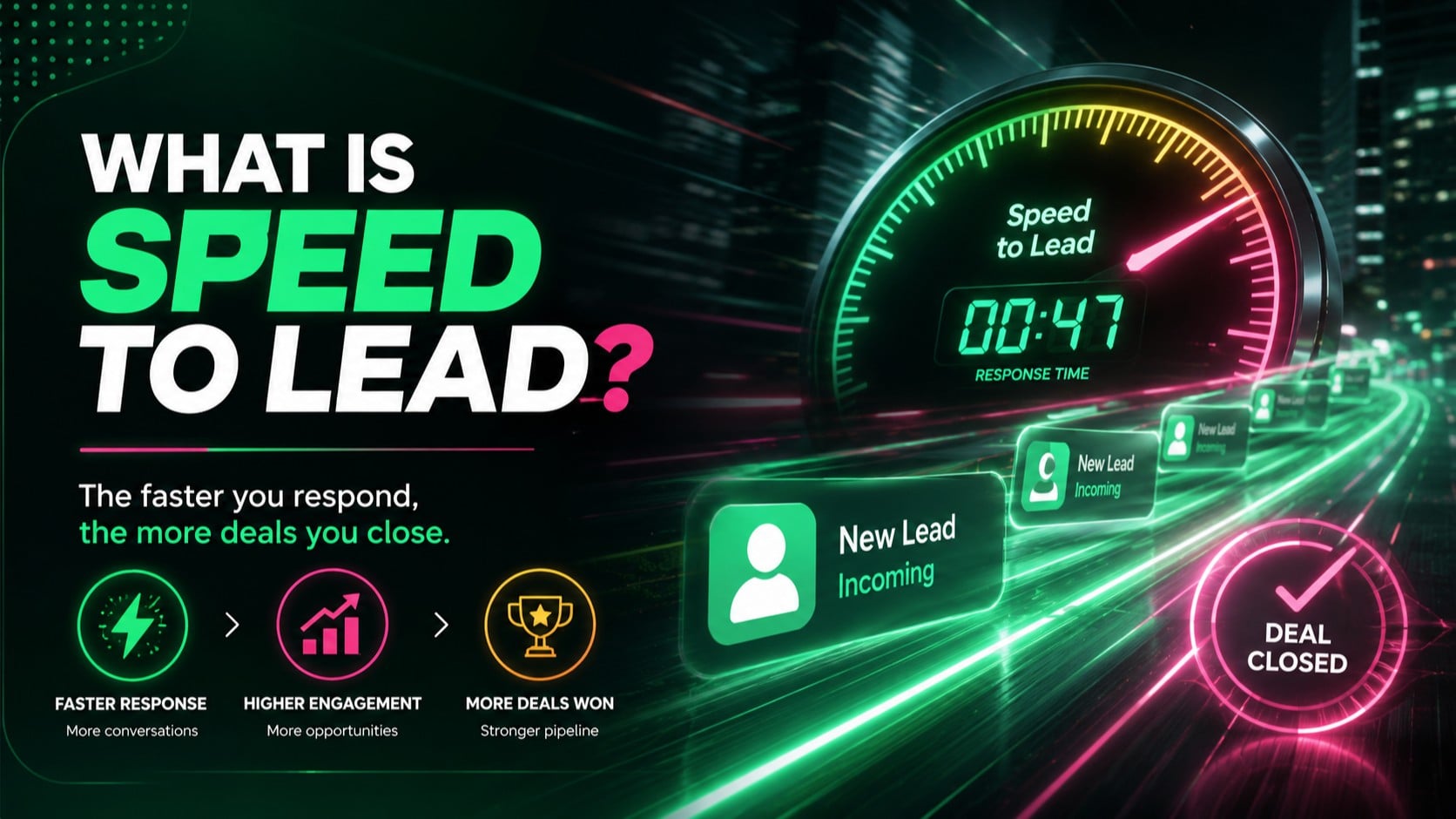
- MIT research reveals a devastating 100x decay in lead contact rates when response time increases from 5 to 30 minutes, making rapid follow-up crucial for sales success.
- The qualification odds drop 21x after 30 minutes, while industry benchmarks show most businesses fail catastrophically at speed to lead with average response times exceeding one day.
- True 24/7 human coverage requires 5.4 FTE and costs over $330,000 annually, making AI-powered solutions necessary for competitive response times.
- AI systems can respond in seconds versus minutes, with SMS achieving 30-50% reply rates compared to email’s 6% response rates.
MIT Research Reveals Devastating 100x Contact Decay
The most rigorous study on lead response timing came from MIT in partnership with InsideSales.com, analyzing over 15,000 web leads and 100,000 call attempts across six companies. The results were stark: businesses that waited 30 minutes to contact a lead had 100 times lower odds of making contact compared to those who responded within 5 minutes.
This isn’t a marginal difference—it’s a complete erosion of opportunity. The study tracked real sales scenarios across multiple industries, measuring both contact rates and qualification success. What emerged was a clear pattern: buyer intent decays exponentially, not linearly. The first five minutes represent a golden window that, once closed, becomes nearly impossible to reopen.
The research methodology was rigorous, examining the effect of day of week, time of day, and response time on conversion outcomes. Response time emerged as the dominant factor, dwarfing all other variables in its impact on sales success. Calculate your potential revenue impact from improved speed to lead to understand what delayed responses cost your business.
The Real Cost of Slow Response
Qualification Odds Drop 21x After 30 Minutes
Beyond initial contact, the MIT study revealed an even more damaging statistic: the odds of qualifying a lead dropped 21 times when comparing 5-minute versus 30-minute response times. Qualification represents the critical step where interest transforms into sales opportunity—and this window closes faster than most businesses realize.
The qualification decay happens because buyer intent operates on emotional peaks. When someone submits a form or requests information, they’re at maximum engagement. Their problem feels urgent, their motivation is high, and they’re mentally prepared to move forward. Every minute that passes allows doubt to creep in, urgency to fade, and competing priorities to emerge.
Industry Response Benchmarks Reveal Massive Gaps
Harvard Business Review’s audit of 2,241 U.S. companies exposed the widespread failure to capitalize on this research. Only 37% of businesses responded to leads within one hour, while 23% never responded at all. Among those that did respond within 30 days, the average response time was 42 hours—well beyond any window of optimal engagement.
More recent studies show little improvement. Only 27% of leads ever get contacted at all according to Salesforce research. Among responders, industry benchmarks such as the Harvard Business Review study show average response times exceeding one day. This persistent gap between knowledge and execution creates massive opportunities for businesses that can bridge it effectively.
Lost Revenue From Wasted Marketing Spend
The economic impact extends beyond individual lost sales to systemic waste of marketing investments. When businesses pay for Google ads, social media campaigns, or lead generation services, slow response times burn that investment. Every dollar spent acquiring a lead that goes uncontacted or receives delayed follow-up represents pure waste.
Consider a business spending $50,000 monthly on lead generation with a 20% conversion rate. If speed to lead improvements could increase conversion to 30%—a realistic improvement based on the MIT findings—the incremental revenue from the same marketing spend would be substantial. The compound effect over time represents millions in otherwise lost opportunity.
Why Most Businesses Fail at Speed to Lead
Manual Lead Assignment Creates Fatal Delays
The Harvard Business Review study identified several operational bottlenecks that prevent rapid response. The most common culprit: batch processing of leads rather than real-time engagement. Many businesses still retrieve leads from CRM systems daily rather than continuously, creating artificial delays even before human response time becomes a factor.
Territory-based routing adds another layer of delay. When leads must be sorted by geography, product type, or rep availability before assignment, precious minutes tick away. The original urgency that prompted the inquiry dissipates while internal systems shuffle the lead through approval workflows and assignment logic.
Inefficient Manual Routing Processes Cause Bottlenecks
Sales teams often prioritize self-generated leads over inbound inquiries, creating a backward incentive structure. Reps focus on prospects they’ve personally sourced while allowing higher-intent inbound leads to wait in queues. This misalignment stems from commission structures and cultural biases that value “hunter” activity over “farmer” responsiveness.
Round-robin and fairness-based routing systems, while equitable, often conflict with speed requirements. When the goal is distributing leads evenly rather than responding fastest, optimal timing takes a backseat to internal politics. The result: leads go to whoever’s “turn” it is rather than who can respond immediately.
Sales Teams Prioritize Wrong Leads
Without sophisticated lead scoring, sales teams struggle to identify which inquiries deserve immediate attention versus nurture sequences. A demo request gets the same treatment as a newsletter signup, diluting focus and slowing response to truly hot prospects. This lack of prioritization means high-intent leads often wait while reps chase lower-probability opportunities.
The problem compounds during high-volume periods. When lead flow exceeds team capacity, everything slows down proportionally. Without automated triage systems, sales teams become bottlenecks rather than accelerators, creating the exact opposite of optimal speed to lead performance.
The Economic Reality of Human-Only Response
5.4 FTE Required for True 24/7 Coverage
The mathematics of round-the-clock human coverage reveal why most businesses struggle with consistent speed to lead. One always-covered position requires 168 hours per week, translating to 4.2 full-time equivalent employees before accounting for any real-world factors like breaks, training, or time off.
Industry guidance from call center operations suggests 5.4 FTE as a more realistic requirement for true 24/7 coverage with holiday and sickness coverage. This accounts for shrinkage—the gap between scheduled hours and productive availability that affects all human-based operations.
$330,000+ Annual Cost for 24/7 Position Staffing
Using median U.S. wages for customer service representatives at $42,830 annually, the 5.4 FTE requirement translates to approximately $231,300 in base wages. When factoring in benefits at 29.9% of total compensation (per Bureau of Labor Statistics data), the fully loaded cost approaches $330,000 annually for a single 24/7 response position.
For businesses requiring sales-level expertise rather than basic customer service, costs escalate dramatically. Using median wholesale/manufacturing sales representative wages of $74,100, the same 5.4 FTE model reaches approximately $570,700 annually in fully loaded compensation—before considering recruiting, training, management, or technology costs.
Idle Capacity During Low-Volume Periods
The core economic pain of human-only speed to lead lies in capacity utilization. Businesses must staff for peak periods and urgent responses, but lead generation rarely follows predictable patterns. During quiet hours, expensive sales personnel sit idle while fixed costs continue accumulating.
This creates an unsustainable cost structure for most businesses. The choice becomes maintaining expensive always-on capacity or accepting degraded response times during coverage gaps. Neither option optimally serves the fundamental business goal of converting leads to customers at reasonable cost.
AI-Powered Solutions Bridge the Gap
Seconds vs Minutes Response Times
Artificial intelligence eliminates the fundamental constraint of human availability. AI systems can process and respond to leads within seconds of submission, operating continuously without breaks, shifts, or capacity limitations. This represents a quantum leap from human-dependent response times measured in minutes or hours.
The technology can simultaneously handle multiple conversations, instantly access relevant context, and maintain consistent quality across all interactions. Unlike human agents who handle one conversation at a time and may lack immediate access to customer history, AI systems operate with perfect recall and unlimited parallel processing capacity.
SMS Achieves 30-50% Reply Rates
The communication channel matters as much as response timing. While email open rates average around 20-28% with reply rates typically around 6%, SMS messages achieve near-universal read rates (around 98%) with reply rates consistently reaching 30-50%. This dramatic difference in engagement levels amplifies the value of rapid response timing.
SMS feels personal and immediate in ways that email cannot match. People read text messages in full, almost universally, creating a direct line to prospect attention during peak engagement periods. Combined with AI’s instant response capability, SMS becomes the optimal channel for capitalizing on the critical first five minutes after lead generation.
MAXED AI’s SwiftX Delivers Instant Lead Response at Scale
MAXED AI’s SwiftX system exemplifies how advanced AI can bridge the speed to lead gap that traditional approaches cannot solve. The platform responds to new leads within seconds through intelligent SMS engagement, holding natural conversations that qualify interest and book appointments before human sales teams even receive notifications.
The system operates on a performance basis, ensuring businesses pay only for results rather than technology overhead. This model removes the risk associated with implementing new sales technology while providing immediate access to response capabilities that would otherwise require substantial human resource investments.
SwiftX integrates seamlessly with existing lead sources—Facebook ads, Google forms, website inquiries, landing pages—ensuring no lead escapes the rapid response window regardless of origin. The AI qualifies prospects, answers initial questions, and schedules follow-up calls, transforming cold inquiries into warm, qualified appointments before human intervention becomes necessary.
The platform’s two-line SMS formula consistently generates 30-50% reply rates by creating conversational engagement that feels personal rather than automated. When prospects respond, the AI maintains context throughout the conversation, building rapport while systematically moving qualified leads toward sales appointments.
For businesses serious about maximizing lead conversion while minimizing response infrastructure costs, MAXED AI provides the technology foundation to compete effectively in markets where speed determines winners and losers. Discover how MAXED AI transforms lead response timing to capture revenue that traditional sales processes leave on the table.
MAXED AI
13801 N Scottsdale Rd
#151-17
Scottsdale
Arizona
85254
United States


