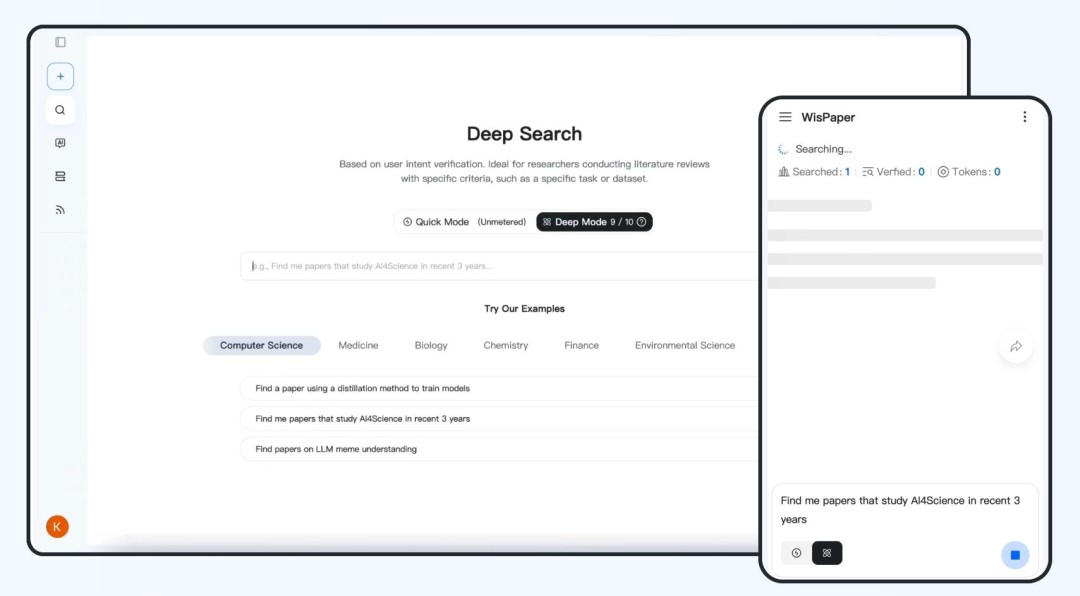
WisPaper, an AI-powered academic research agent, today introduced capabilities designed to lower the technical barriers associated with scientific research. The system addresses a common challenge across disciplines: researchers face constraints not in generating ideas, but in executing them due to limitations in programming, data handling, and experimental setup.
Shifting Focus from Skills to Ideas
In traditional research environments, advancing an idea often requires a combination of domain knowledge and technical implementation skills. Tasks such as configuring computational environments, writing code, and processing data can become bottlenecks, particularly for researchers without strong engineering backgrounds.
WisPaper is designed to reduce this dependency. By supporting tasks across literature analysis, experiment setup, and execution, the system allows researchers to engage more directly with conceptual questions, rather than the mechanics of implementation.
Broadening Participation in Complex Research
Lowering technical thresholds may enable a wider range of researchers to participate in computational and data-intensive studies. Fields that typically require specialized coding expertise, such as machine learning-based analysis or simulation-driven research, can become more accessible when execution is handled within an integrated system.
This shift may also reduce the gap between researchers with different technical backgrounds, allowing those with strong domain expertise but limited programming experience to contribute more actively to complex projects.
Redefining Research Capabilities
As technical constraints become less central, the definition of research capability may evolve. Instead of being determined by the ability to implement experiments from scratch, it may increasingly depend on how effectively researchers define problems, frame hypotheses, and interpret results.
This change supports a model in which scientific work is driven more by the quality of questions than by the ability to carry out procedural tasks. In such a framework, idea generation and critical thinking take on greater importance relative to execution.
Toward More Inclusive Research Workflows
By reducing reliance on specialized technical skills, WisPaper contributes to a broader shift toward more inclusive research workflows. As tools continue to abstract complexity, researchers across disciplines may find it easier to test ideas and engage with emerging areas of study.
About WisPaper
WisPaper is an AI-powered academic research agent designed as a full-chain research accelerator. It supports literature retrieval, analysis, experiment design, execution, and paper writing within a unified workflow, helping researchers manage complex scientific tasks more efficiently across disciplines.
For more information, visit http://wispaper.ai/?utm_source=news.
Media Contact
Company Name: WisPaper
Contact Person: Sean Young
Email: Send Email
Country: Singapore
Website: http://wispaper.ai/?utm_source=news