27 senior HR leaders picked five AI questions worth a year of research. On September 9, the people leading that work will present them live.
BOSTON, MA, UNITED STATES, August 25, 2026 /EINPresswire.com/ — The Human-Centric AI Council opens Year Two with a free public town hall on Wednesday, September 9, 2026, at 1:00 p.m. ET. Five workstream leaders will present the research agenda that 27 senior HR practitioners set for the coming year, then open the floor to everyone in the room. Registration is open at kyleandco.com/aicouncil.
The agenda exists because the industry’s default question stopped being useful.
Year One of the Council started with a fundamental question: What is AI, and what is it about to do to our work? Year Two starts somewhere harder: What is human? As AI moves from assisting employees to automating workflows and, increasingly, acting autonomously, the Council is turning that question into five practical research priorities for HR.
“How should HR use AI is too big to answer and too easy to answer badly,” said Kyle Lagunas, Founder and Principal Analyst at Kyle & Co and Founder of the Human-Centric AI Council. “So the Council broke it into five questions a practitioner can do something with.”
Why this matters now
Lagunas sorts hiring AI into three categories: assistive, automated, and autonomous. Assistive AI works with a team, drafting the outreach a recruiter then edits. Automated AI works for a team, running a workflow someone already defined. Autonomous AI works instead of a team, making and acting on decisions with no human in the loop.
The distinction determines what happens when the technology is wrong.
“When assistive AI gets it wrong, a recruiter catches it in the draft. When automated AI gets it wrong, a workflow misfires, which is irritating and visible and cheap to fix,” Lagunas said. “Autonomous is trickier. A qualified candidate disappears and nothing fires. No hiring manager lands in your inbox, because the person they would have loved never made it far enough to be missed. The absence of a candidate is not something your dashboard was built to surface.”
Product demos do not close that gap. A demo is a success case with a clean script and a cooperative candidate, which means buyers evaluate the ceiling of a tool and find the floor after they have deployed it.
What the town hall covers
Each of the Council’s five Year Two workstreams sits somewhere on that line, and each leader presents their work on September 9:
Where AI is already changing the work. Which HR tasks are being augmented, which are being automated, and which stay with human judgment, mapped task by task rather than argued in the abstract. Led by Kirandeep Virdi.
What the HR operating model looks like after. Role redesign for talent acquisition, HR business partners, learning and development, and HR operations once assistive and automated AI are embedded in the work. Led by Clayton Rodgers.
Where autonomous decisions are off the table. Decision rights and human accountability in hiring, performance, pay and terminations, plus a risk index scored by vendor and by HR process. Led by Susan Jackson.
What makes assistive AI safe. Assistive AI only works when the person using it can catch the error in the draft. Turning AI literacy into role-specific practice that survives contact with real work. Led by Jelena Marjanovic, PhD.
What the demos never show. Four to six published analyses of real AI implementations, covering what worked, what did not, and what it cost in business and human terms. Led by Rob Devlin.
Attendees can question the agenda directly. The Council revises its research priorities based on what the room raises, which is the reason the town hall is open rather than members-only.
Built by the people doing the work
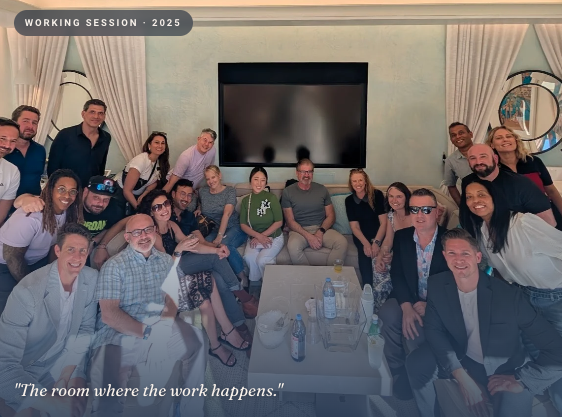
The Year Two cohort includes 27 senior HR and talent leaders across five pillars, spanning HR technology, talent acquisition, people operations, transformation, governance and workforce strategy. Members implement AI inside their own organizations and meet regularly to pressure-test the frameworks they are building.
“It’s a working council, not a conversation club,” Lagunas said. “These are people dealing with AI transformation inside real organizations, with real employees, real constraints and real consequences. The point isn’t to predict the future from the sidelines. It’s to build things that help HR lead it.”
Year One produced four resources now in use across HR organizations: an AI Literacy Toolkit and applied learning course, a Responsible AI Transformation Framework, an AI change management ebook, and an AI Solution Evaluation and Design Framework. Everything the Council publishes is free and open to the HR community.
The industry funds it, practitioners lead it
Year Two is underwritten by Cornerstone on Demand, Glider, CodeSignal, HiBob, Gem and GoodTime.io, with additional underwriting positions open.
Underwriters fund the work and participate in market-level dialogue with practitioners. They do not set the research agenda, assign workstreams, or control what the Council publishes. The separation is deliberate, and it gives technology companies a way to support and learn from practitioner work without steering it.
“Credit follows contribution, never the invoice,” Lagunas said.
HR technology companies are welcome to attend the September 9 town hall as guests. Two of the five workstreams produce outputs that reach vendor products directly, including the risk index and the published implementation analyses.
Registration
The Year Two Town Hall is Wednesday, September 9, 2026 at 1:00 p.m. ET, free and open to anyone. Registration adds the calendar invite and join link automatically, and everyone who registers receives the recording.
Register at kyleandco.com/aicouncil.
About the Human-Centric AI Council
The Human-Centric AI Council is a practitioner-led working group of senior HR, talent and people leaders building practical resources for responsible, people-first AI adoption. Founded by Kyle Lagunas and Kyle & Co, the Council develops frameworks, tools and research grounded in the realities of implementing AI inside organizations. Council resources are free and open to the HR community.
About Kyle & Co
Kyle & Co is an independent HR research and advisory firm built with HR practitioners. Founded by industry analyst Kyle Lagunas, the firm helps HR organizations close the gap between AI innovation and adoption through independent research, practitioner-led analysis, strategic advisory and implementation support. Its work is grounded in a simple principle: Where Research Meets Reality.
Evan White
Evan White PR
+1 509-995-9105
email us here
Visit us on social media:
LinkedIn
Legal Disclaimer:
EIN Presswire provides this news content “as is” without warranty of any kind. We do not accept any responsibility or liability
for the accuracy, content, images, videos, licenses, completeness, legality, or reliability of the information contained in this
article. If you have any complaints or copyright issues related to this article, kindly contact the author above.

Media gallery